
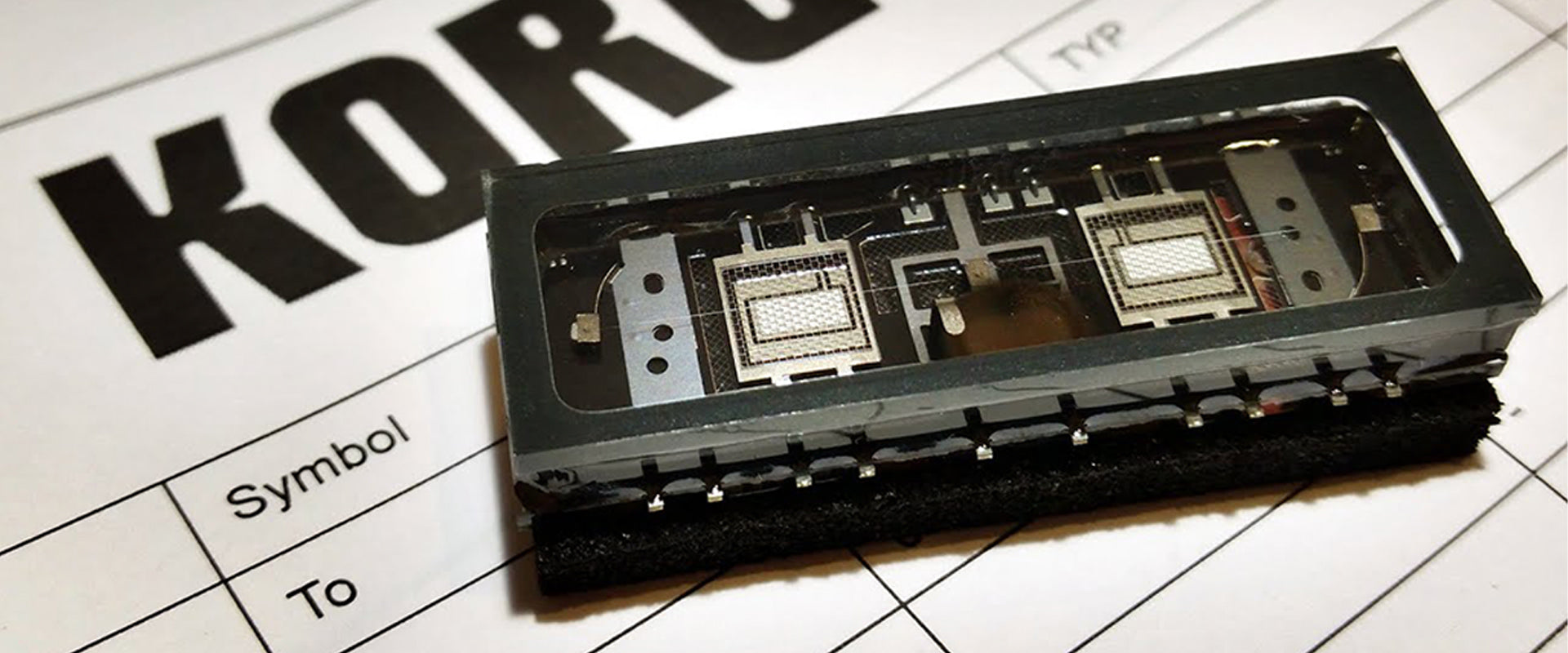
Korg Nutube 6P1
Classic Triode Behavior Without Classic Limitations
We often receive questions about whether the Nutube 6P1 used as the preamp in écoute headphones is a genuine vacuum tube. The answer is yes. The Nutube 6P1 is a real dual‑triode vacuum device, built on the same anode–grid–filament principles as traditional vacuum tubes, and it produces the same characteristic harmonic behavior associated with classic triode designs.
At its core, the Nutube operates on the same fundamental physics that have defined vacuum‑tube audio for more than a century. A heated filament emits electrons through thermionic emission. Those electrons travel through a sealed vacuum, where their flow is shaped by a control grid and collected by an anode. That controlled electron flow is translated into a corresponding voltage variation at the anode—what we recognize as the audio signal—complete with the natural even‑order harmonics and gradual non‑linearity associated with triode operation. Nothing about that process is simulated or digitally approximated—it is real electron flow in a real vacuum.
A Minimized Form Factor
What makes the Nutube 6P1 look unusual is not a change in function, but a change in physical layout. Instead of the traditional cylindrical glass bottle with vertically stacked elements, the Nutube uses a planar triode structure derived from vacuum‑fluorescent display (VFD) manufacturing techniques. The anode, grid, and filament are arranged laterally inside a flat, sealed glass envelope—often described as a “glass sandwich.”

This planar geometry preserves true triode operation while dramatically reducing volume. A closer look at the internal structure still reveals all the familiar elements of a conventional triode, re‑arranged into a more efficient layout.
Low Voltage Without Low Fidelity
A common misconception is that any tube operating at low voltage must be running in a so‑called “starved plate” condition. In classic tube design, this term refers to operating a tube well below its intended plate voltage, forcing it outside its optimal linear region. In those cases, distortion characteristics change, headroom collapses, and the tube’s behavior is no longer representative of proper triode operation.
The Nutube 6P1 does not fall into this category. It is not a high‑voltage tube being artificially constrained. It is a purpose‑built low‑voltage triode, designed from the ground up to operate linearly and predictably at the voltages it uses.
Traditional small‑signal vacuum tubes typically operate with plate voltages in the 100–300 volt range and require multiple watts of heater power. The Nutube 6P1 achieves the same triode behavior while operating at dramatically lower voltages. Its filament operates at well under one volt, and its anode can operate effectively at voltages commonly associated with solid‑state circuits—typically in the low‑teens.
This is not achieved by reducing the role of the vacuum or grid, but by optimizing the geometry and spacing of the electrodes so electrons can be emitted, accelerated, and controlled efficiently at much lower energy levels. In other words, the Nutube is not operating under compromised conditions—it is operating exactly where it was designed to operate. The result is true thermionic emission without the excessive heat and power consumption normally associated with conventional vacuum tubes.
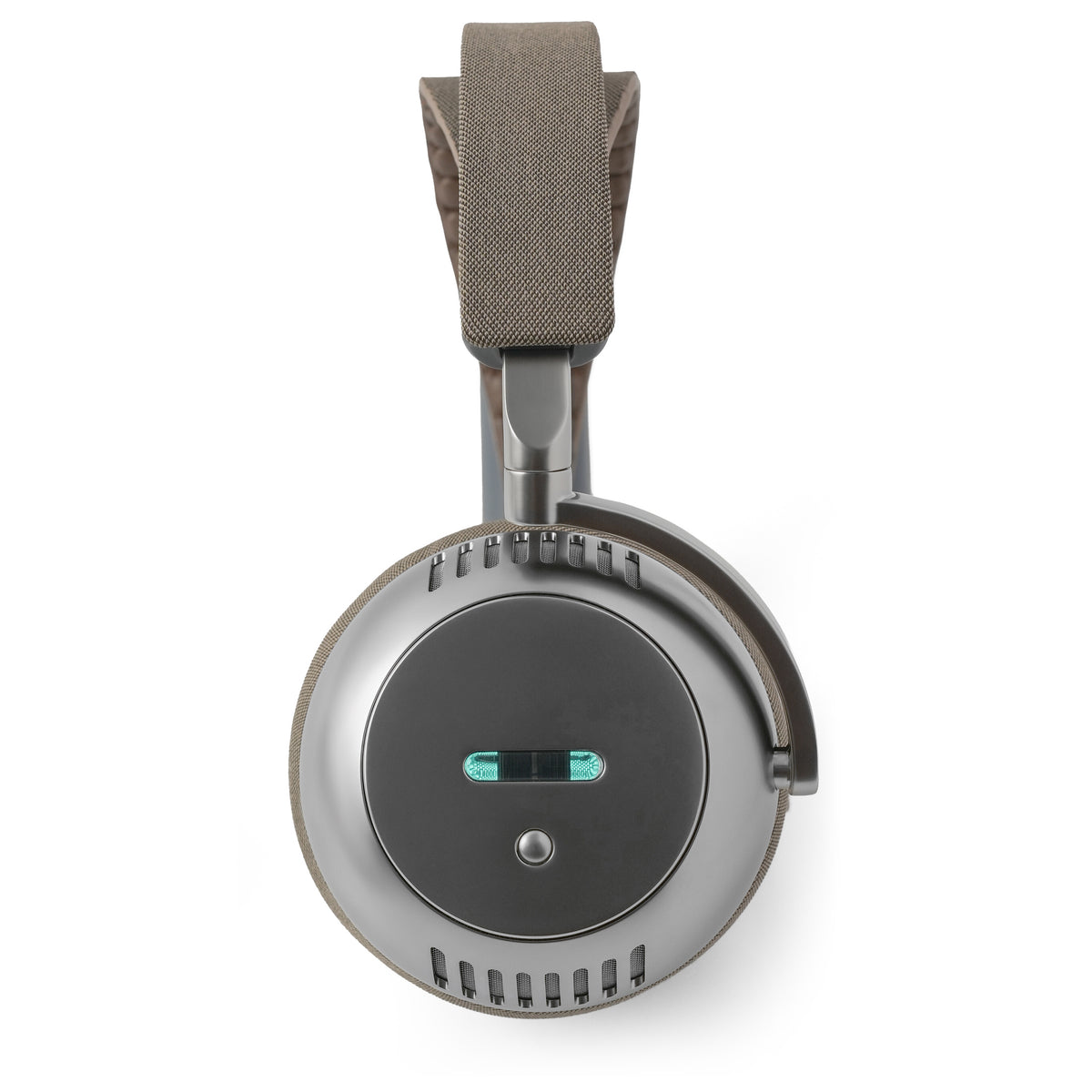
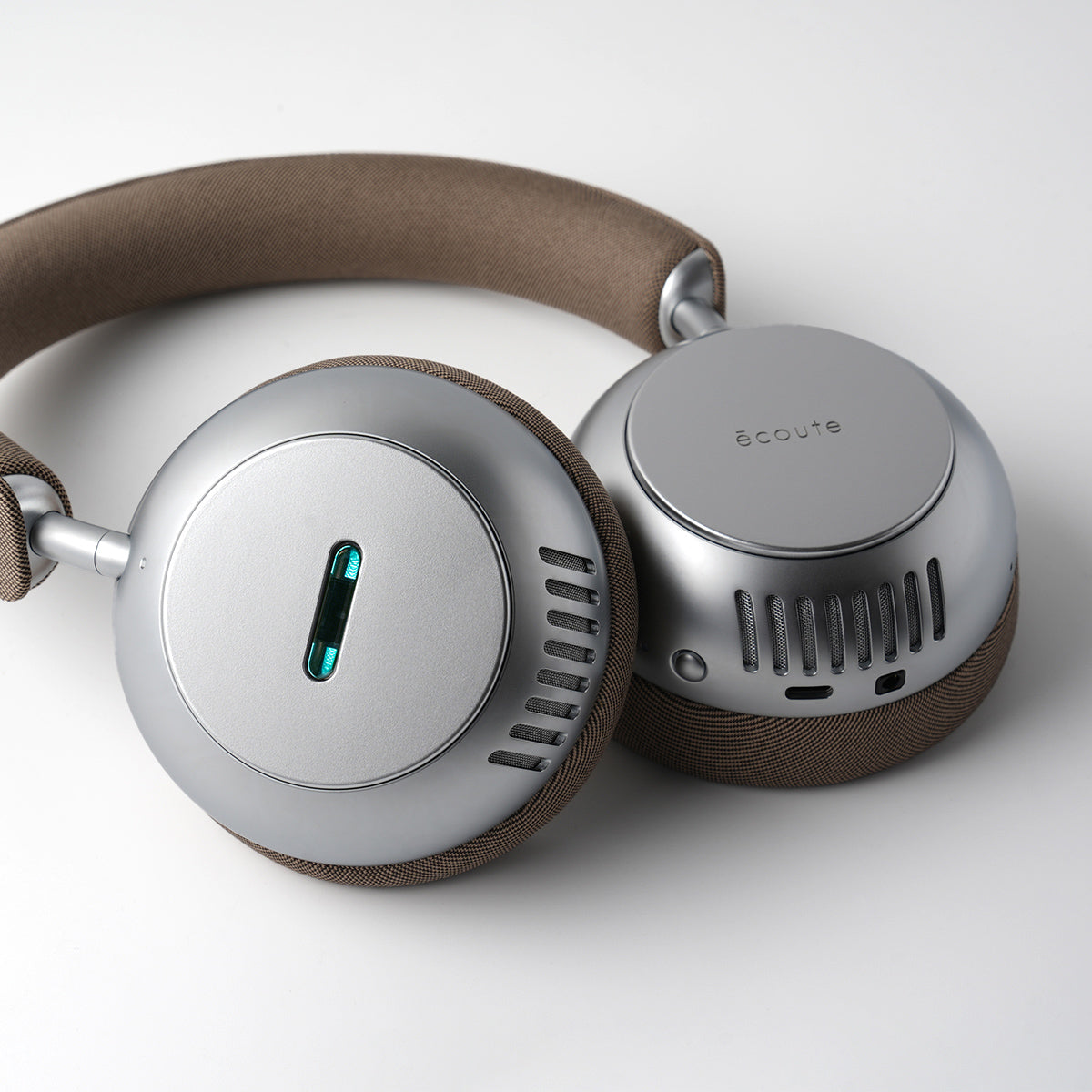
Because its power dissipation is measured in milliwatts rather than watts, the Nutube runs cool and remains electrically stable. There is no need for bulky ventilation, high‑temperature enclosures, or extended warm‑up times. This is what allows a genuine vacuum‑tube preamp stage to exist inside a compact, battery‑powered product like écoute headphones.
(And no—we regret to inform everyone that écoute headphones do not double as heated earmuffs. The mix may sound warmer, but the headphones themselves don’t produce any extra heat.)
Same Philosophy, Same Results
From an audio perspective, the Nutube behaves like a triode because it is one. Its transfer characteristics naturally produce even‑order harmonic content—particularly second‑order harmonics—which reinforce musical fundamentals rather than masking them. This contributes to the sense of dimensionality, tonal density, and midrange realism traditionally associated with tube preamplifiers.
Crucially, this harmonic structure is not added as an effect or imposed through signal processing.
A triode’s sonic character is determined primarily by:
- The shape of its transfer curve
- The relationship between grid voltage and plate current
- The dominance of even‑order harmonics in its distortion spectrum
Those characteristics exist regardless of absolute voltage, so long as the device is correctly biased and operated within its intended linear region—which is precisely how the Nutube is designed to be used. The Nutube’s excellent linearity in the small‑signal region makes it especially well suited to preamp applications, where nuance, texture, and micro‑dynamics matter more than brute power.
Put simply, high voltage was once necessary to achieve triode behavior. It is no longer required to preserve it.
Mechanical Stability and Microphonics
Another common concern with all vacuum tubes—especially in portable products—is microphonics: the tendency for mechanical vibration to modulate the audio signal. This is not a defect or anomaly; it is an inherent characteristic of any device that relies on suspended internal structures and electron flow in a vacuum. All tubes are microphonic to some degree.
Traditional glass tubes tend to make this behavior more pronounced. Their tall cylindrical form factors, higher operating voltages, and relatively massive internal elements create greater mechanical leverage, allowing vibration to translate more easily into audible signal modulation.
The Nutube 6P1 does not eliminate microphonics—but it does reduce their magnitude and audibility through design. Its planar structure has far lower mechanical leverage and significantly less moving mass than classic bottle‑style tubes. In our application, the Nutube is housed inside an internal enclosure rather than being exposed to open air, providing both acoustic isolation and environmental stability.
Within écoute headphones, the Nutube is further isolated by internal damping and mounting strategies designed specifically to control vibration. The surrounding headphone structure adds additional mechanical damping, and the way headphones interface with the human body contributes as well. The padding, headband, and the natural mechanical compliance of the neck and spine act as effective absorbers of high‑frequency mechanical energy. In practice, while the Nutube remains microphonic—as all tubes are—it is well isolated from both acoustic pressure and mechanical vibration, keeping those effects below audibility in real‑world use.
Why Traditional Tubes Were Never Practical in Headphones
Classic vacuum tubes were never excluded from portable or headphone applications because of sound quality—they were excluded because of physics. Traditional glass-bottle triodes were designed for stationary equipment with access to high-voltage power supplies, ample ventilation, and mechanical isolation—conditions that simply do not exist in a wearable product.
Conventional tubes typically require hundreds of volts on the plate and several watts of continuous heater power. That introduces immediate obstacles for portable use: inefficient battery drain, significant heat generation, long warm-up times, and bulky power-conversion circuitry. In a headphone-sized enclosure, those requirements are not merely inconvenient—they are prohibitive.
Mechanical fragility compounds the problem. Glass tubes are tall, relatively heavy, and mechanically sensitive. In a product that moves with the listener and is exposed to constant vibration, traditional tubes would be prone to microphonics, noise, and premature failure. Historically, this is why tube-based headphone systems have always required external amplifiers rather than one built into the headphones themselves.
The Nutube 6P1 was designed specifically to overcome these very constraints. Its low-voltage operation eliminates the heat and power demands that made classic tubes impractical, while its planar structure, sealed enclosure, and low-mass internal elements provide mechanical stability in environments where traditional tubes would struggle—making true triode operation not just possible, but practical.
Gain, Role, and Bias Stability
It’s also important to understand what role the Nutube plays in the signal chain. Like classic small-signal triodes such as the 12AX7 or 6SN7, the Nutube is used as a preamp stage—not as a high-power voltage amplifier. Its purpose is not brute gain, but signal shaping: establishing timbre, harmonic structure, and micro-dynamic behavior before the amplification stage.
The Nutube’s gain factor is intentionally modest, optimized for linearity and stability rather than maximum voltage swing. This mirrors how many classic tube stages are used in high-end audio systems, where excess gain is avoided in favor of headroom, low noise, and predictable behavior.
Because the Nutube is manufactured using modern processes with tight tolerances, it also exhibits excellent unit-to-unit consistency. Bias points are predictable and stable over time, reducing the variability commonly associated with traditional tubes and eliminating the need for frequent adjustment or matching.
Where It Differs from Traditional Tubes
While the Nutube 6P1 is functionally equivalent to a conventional triode, it differs in several important practical ways:
- Power consumption is a small fraction of that required by traditional vacuum tubes, enabling battery operation.
- Heat generation is minimal, improving stability and long‑term reliability.
- The flat, compact form factor allows placement where cylindrical tubes simply would not fit.
- Rated operational life extends to tens of thousands of hours, exceeding the expected lifespan of most portable audio products.
What it does not change is the role of the tube itself. The Nutube remains a preamp stage. It still shapes timbre, harmonic balance, and micro‑dynamics in the same way a traditional triode does. It simply does so using a more efficient front‑end technology.
A Triode, Reimagined
Yes, the Nutube 6P1 looks different from the glowing bottles of classic hi‑fi gear. But its purpose is unchanged. It exists to do what vacuum tubes have always done best: shape music in a way that preserves nuance, coherence, and emotional realism.
The Nutube represents the evolution of triode technology—not its abandonment. It preserves the defining elements of a true triode—vacuum operation, thermionic emission, and grid‑controlled electron flow—along with the philosophy, function, and sonic results that follow, while discarding the inefficiencies that once limited where true vacuum‑tube audio could exist.

Leave a comment
This site is protected by hCaptcha and the hCaptcha Privacy Policy and Terms of Service apply.