

Why Digital Got a Bad Rap: The Format Isn't the Problem. The Playback Is.
The listeners were right. The engineers were right. Everyone was wrong.
In 1983 a great many people began saying the same thing at once.
The compact disc had arrived, marketed as perfect sound forever, and on paper it deserved the slogan. Wider dynamic range. No surface noise. No wear. Measurably superior to the format it replaced in nearly every respect an engineer could put a number to.
When listeners reported that it sounded cold — harsh, clinical, thin — they were told they were imagining it, and that it was just nostalgia talking, because the measurements said otherwise.
The argument is still running, and it has hardened into two camps. One says digital is lifeless and that vinyl is what serious listening sounds like. The other says vinyl is just ritual and nostalgia with nothing behind it a measurement can find.
Both are repeated with total confidence. Both are missing the same thing.
Forty years of arguing about formats, and the thing that actually changed was somewhere else entirely.
There is no such thing as digital music
Not as something you can hear.
A speaker is a mechanical object. A diaphragm moves, it pushes air, and air carries pressure waves to your ear. That process is continuous. There is no version of listening that isn't analog at the moment of delivery.
What's digital is only the storage. An MP3, a WAV, a CD — ones and zeros in a file. The code isn't physical and it makes no sound. Think of it as words on a page: recorded information, silent until someone decodes it and reads it aloud. A digital-to-analog converter is the reader. Everything downstream of that point is analog, including every amplifier — tube, solid-state, even Class D, which switches rather than amplifies continuously but still hands the driver an analog voltage once its output filter has done the work.
So "digital music sounds harsh" is a sentence about nothing. Digital is just the storage format. What you hear is the playback — the reading — and whatever the signal path does on the way to your ears.
Which means the difference people heard in 1983 was real. It just wasn't where anyone was looking.
Even-order harmonics, and why they matter
Real sound is harmonically rich. A violin in a hall, a voice across a table — the fundamental arrives surrounded by overtones and harmonic texture, and the low even-order ones sit consonant with it. Second order is one octave above the fundamental. Fourth is two octaves up. They don't fight the note. They belong to it, and they fill it out.
We hear that richness constantly in the physical world, which is why its presence reads as real and its absence reads as thin and artificial.
Much of that richness doesn't survive to the master. Microphone placement, mixing, compression, mastering — each step flattens it. By the time a recording is finished, some of what made the original event feel real has been pressed out of it.
That's true of every recording ever made, analog or digital. It's a consequence of capturing sound, not of storing it.
Which raises a question. If every recording loses that content, why did anything ever sound right?
The answer was in the playback
When you play a record, the playback chain is not neutral. Groove geometry, stylus tracing, the cartridge, the phono stage — each one colors the signal on its way out.
For most of a century that coloration was simply a fact of listening. Every home system had it. It arrived at the source, before the signal ever reached the amplifier, and it was doing real work: putting body back into recordings that had been thinned by the process of making them.
Nobody understood it as restoration. You cannot isolate a variable present in every system you have ever heard. The turntable wasn't understood as a component that contributed character — there was nothing to compare it against. It simply sounded right, and right was the baseline.
Solid-state amplification took over through the 1970s, and those systems sounded good. Transistors were in most receivers well before the CD arrived, and people liked them for their measured fidelity and their convenience. That worked because the record was still supplying the harmonic content and the transistors passed it along faithfully. Nothing was missing yet.
Then the source changed.
The compact disc arrives
Sony's CDP-101 shipped in Japan in late 1982. The format reached the US the following year. And for the first time, a completely uncolored source was feeding a home audio system.
Two things changed at once, but only one was visible.
The first: nothing upstream was adding anything anymore. Whatever the recording had thinned out stayed out, all the way to the speaker. The support structure every listener had been standing on, without knowing it was there, was gone.
The second is subtler and worse. With the source contributing nothing, what remained was the amplifier's own character — now fully exposed. Solid-state circuits, particularly the high-feedback push-pull topologies that dominated consumer gear, tend toward odd-order distortion products: third, fifth, seventh. These are dissonant with the fundamental. Their total percentage is vanishingly low, which is exactly why the measurements looked so good, but — and this is important — total percentage was never the variable that determines how something sounds. It's the type of harmonic distortion that matters more. Which is why listeners consistently describe even minute amounts of odd-order content as hard, brittle, and fatiguing.
So the chain lost the character people liked and was left alone with the character they didn't. Both changes landed the same week, and the only visible difference was the shiny disc.
Of course they blamed the disc.
Early digital playback had real problems of its own, and it's worth saying so. Converter linearity, clock jitter, steep reconstruction filters, careless early mastering — all of it contributed something genuinely harsh, and all of it was fixed over the following two decades. Every one of those problems sat in the machinery reading the disc rather than on the disc itself, which is its own kind of confirmation. But the complaint outlived the fixes. Conversion today is transparent by any measure you like, and people still say digital doesn't sound as good as analog.
Which means something else was going on.
Why THD measurements didn't catch it
The measurements of the day couldn't catch it. A single THD percentage sums every harmonic into one number and weights them all the same — the second order that makes a note feel fuller and the seventh that makes it feel brittle count identically toward the total. Two amplifiers can measure the same and sound nothing alike, and anyone who has heard both already knows it.
A THD measurement isn't lying. It's answering a question nobody should be asking.
Both camps are right. That's why the argument persists.
Here's the part neither camp ever reached, because both were too busy defending their half.
The vinyl camp is describing something real. They were right that something went missing. They noticed a loss in how music felt, refused to pretend otherwise, and pointed at the only difference they could see.
The digital camp is also describing something real. Lower noise floor, wider dynamic range, better channel separation, no wear, no pops, no side to flip halfway through the album. Every one of those is a genuine gain over what vinyl could do.
Both lists are accurate. And for four decades both have assumed the two lists are mutually exclusive — that the harmonic character comes bundled with the surface noise, and the technical performance comes bundled with the thinness. Pick a side, accept the package.
It was never a package. That assumption is the whole disagreement, and it's wrong. The character people love about records was never a property of the format — it was a property of the playback. The format's problems were real, and they're behind us. What never got fixed was the playback chain. It lost a step in 1983, and for a long time nothing replaced it.
Putting the harmonics back
There are two ways.
The first is what listeners have been doing since the eighties: keep an analog medium in the chain and let physical playback supply the character. It works. It's a substantial part of why vinyl came back despite every inconvenience attached to it.
The second is to do the job electrically, and here the physics gets specific in a way that's worth understanding.
A vacuum tube has an asymmetric transfer curve. In a single-ended stage, that asymmetry isn't a defect — it is precisely why a tube gain stage generates predominantly second-order harmonic content, with some fourth. Octaves above the fundamental. Consonant with it. This isn't taste or folklore; it falls directly out of how the device behaves, and it's the same property that has kept tubes in mastering rooms and studio front ends for seventy years.
Which of the two you prefer is taste. Some listeners like the leaner, more analytical presentation solid-state gives them, and there's nothing wrong with that. But it's a preference, not a default — and for four decades it was the only one on offer.
Applied to a digital source, a tube stage supplies that character at the point of amplification rather than the point of playback.
The difference between the two approaches is what you keep. With a record, the character arrives bundled with the medium — surface noise, wear, inner-groove distortion, finite dynamic range, and a side that ends in eighteen minutes. With a tube stage you get the tonal character while the digital source stays exactly as resolved as it was.
You stop choosing between resolution and texture. You were never supposed to have to.
The obvious conclusion
If the argument above holds, the answer isn't complicated. Take the resolution of a digital source and run it through a genuine tube gain stage. You get the detail digital was always capable of delivering and the harmonic character that went missing in 1983 — both, simultaneously. No compromise.
That combination has existed for decades and has always carried a condition: it lives in a room. A shelf of separates, a chair, a wall socket. Getting it right has meant staying home.
Step outside — the commute, the office, the plane — and the chain reverts to the exact configuration that started the argument: a bare digital source through a solid-state path. That's where most listening now happens, and the challenge becomes how to put the harmonics back.
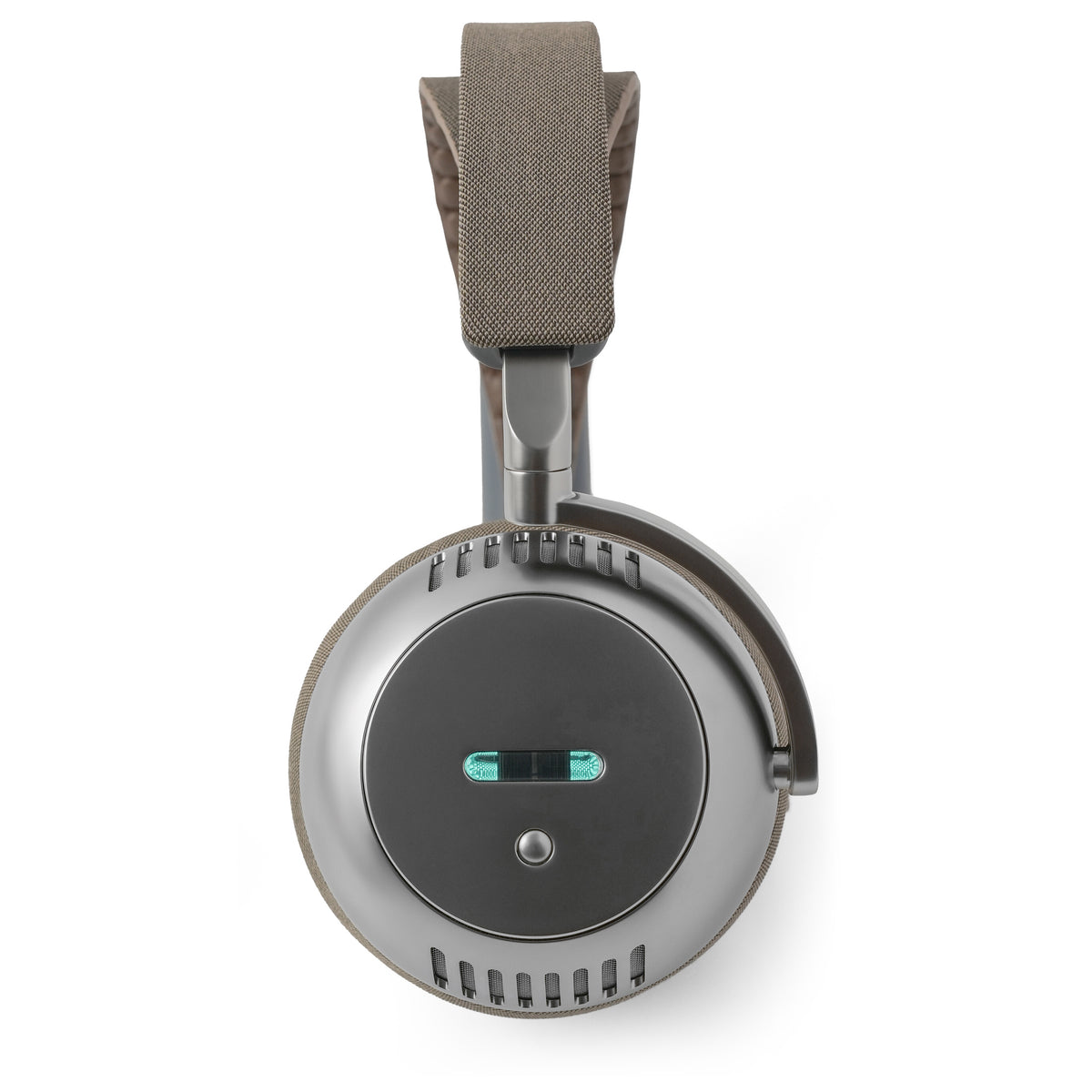
So we built écoute. A real vacuum tube preamp gain stage, dual-mono amplification, fed by a high-resolution digital source — the entire chain, in the headset. Not a tube-flavored EQ curve. The actual architecture, made portable.
It turns out the thing that went missing was never the format. It was a gain stage. And a gain stage can go anywhere. Ours does.




Leave a comment
This site is protected by hCaptcha and the hCaptcha Privacy Policy and Terms of Service apply.